The Asian Assembly
Observation Network
The Asian Assembly Observation Network (AAON) is a civil society-led assembly observation roster designed to promote compliance with international standards on the right to freedom of peaceful assembly in Asia. Members of the AAON are deployed to observe selected key public assemblies in the region. The AAON is composed of representatives from FIDH member and partner organizations from Asia.
The AAON is aimed at strengthening relations between FIDH members and partners, and improve their respective ability to observe assemblies through training sessions and experience sharing among members, and other local, regional, and international stakeholders. It is also designed to express regional solidarity in upholding the right to freedom of peaceful assembly.

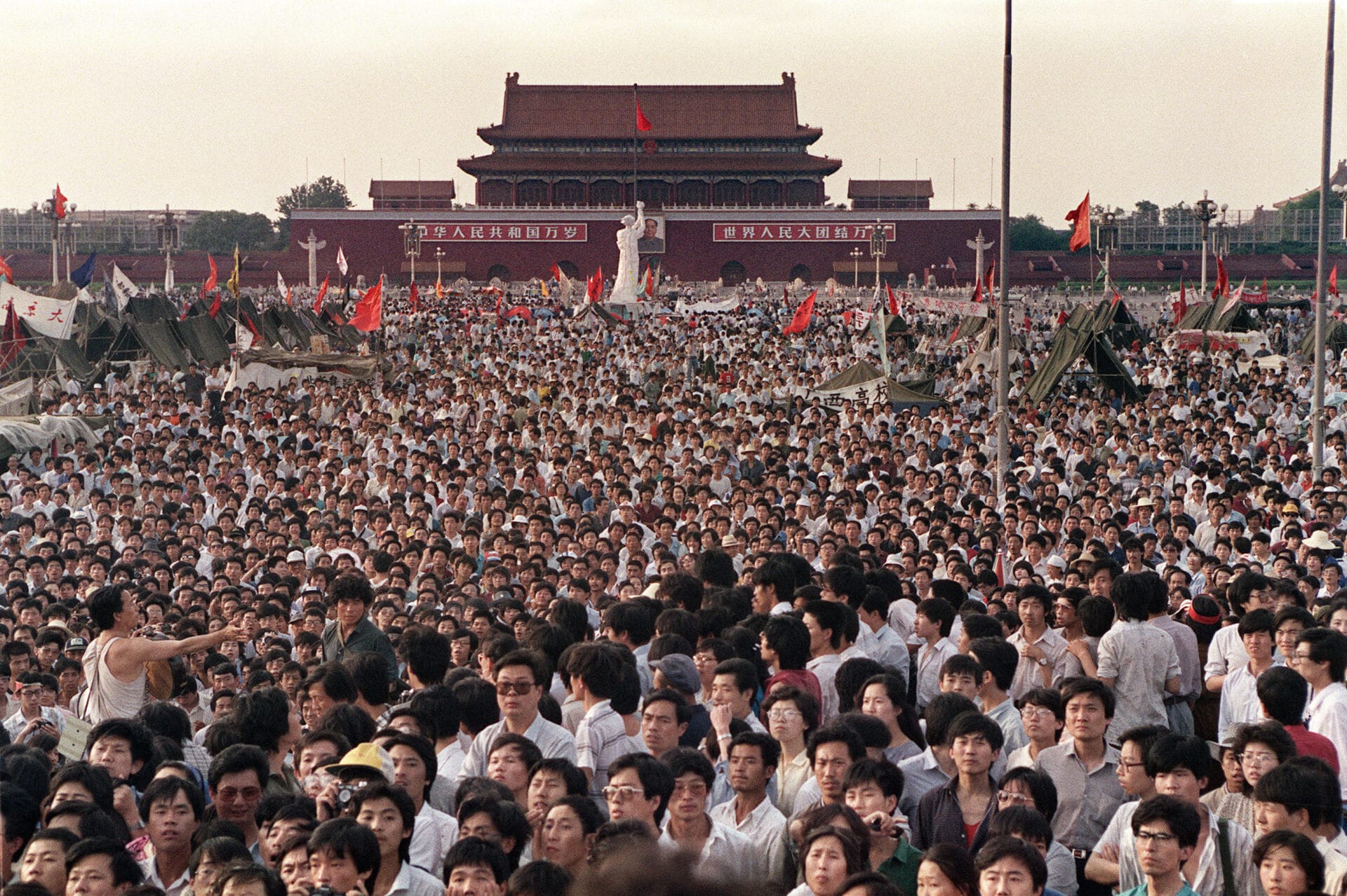
Photo by CATHERINE HENRIETTE / AFP
Hundreds of thousands of Chinese gather on June 2, 1989 in Tiananmen Square around a 10-metre replica of the Statue of Liberty (C), called the Goddess of Democracy, demanding democracy despite martial law in Beijing. Hundreds, possibly thousands, of protesters were killed by China's military on June 3 and 4, 1989, as communist leaders ordered an end to six weeks of unprecedented democracy protests in the heart of the Chinese capital. Dissidents and human rights advocates around the world will mark on June 4, 2009 the twentieth anniversary of China's bloody crackdown on the pro-democracy protests. (Photo by CATHERINE HENRIETTE / AFP)
Coordination
The coordination of the operational aspects of the AAON will be led by the FIDH International Secretariat, namely through the Asia Desk, with the assistance of member and/or partner organizations that act as focal points in countries/territories where the AAON will be deployed for assembly observation missions.
FIDH’s Asia Desk, the members of the AAON, and the FIDH member and/or partner organizations will be involved in consultations and decisions concerning the functioning of the AAON, including aspects related to: composition of the observation missions; planned observation activities; security risk assessment; production of output; and communications and advocacy. Training and preparation sessions will be organized by FIDH’s Asia Desk together with members and/or partner organizations.
Criteria for the composition of the AAON
- The AAON is made up of a minimum of three and a maximum of 15 observers.
- The AAON aims to achieve gender balance.
- The AAON takes into consideration geographic (i.e. country and sub-region of origin) balance.
- The AAON aims to include a mixed level of experience (i.e. those who have significant experience in assembly observation and those who have limited or no experience in assembly observation).
- Participation in the AAON is voluntary and members of the AAON may choose to leave the roster at any time. Any requests for temporary or permanent removal from the AAON should be notified in writing to FIDH.
- The AAON may consist of representatives from FIDH member or partner organizations as well as individual human rights defenders.
Criteria for the composition of an assembly observation mission
- Availability of observers.
- Nature of the assembly (stationary/mobile).
- Size of the assembly.
- Knowledge of political context.
- Security and health risks.
- Logistical and budgetary considerations (visas, flights, other travel requirements).
- Local and foreign language(s) skills.
- Nationality (members of the AAON cannot participate in assembly observation missions carried out in their country of focus).
Criteria for the selection of assemblies to be observed
- Assembly observation missions are limited to large-scale important public events that have been planned and announced several weeks ahead of time. Observation missions can be conducted over a single day or over several days (in cases of ongoing assemblies).
- Assembly observation missions are organized and carried out in countries where FIDH has at least one member or partner organization. This organization must be able to provide sufficient coordination, logistical support, and advice on the local context and emerging circumstances before and during the observation mission.
- A request to observe an assembly may come from: 1) an FIDH member or partner organization; or 2) the FIDH Asia Desk. The decision on whether to conduct an assembly observation mission in Asia is made by the FIDH Asia Desk in consultation with, and the approval of, the member(s)/partner(s) organization(s) in the country/territory in which the assembly in question takes place.
- Assembly observation missions can be carried out only following a security risk assessment in consultation with the FIDH Asia Desk and the member(s)/partner(s) organization(s) in the country/territory in which the assembly in question takes place.
Code of conduct
- Independence and impartiality: Observers assume an independent, neutral, and impartial role and must not participate or engage in any activity of the assembly.
- Compliance with protocols. Observers should adhere to the AAON protocols and other operational aspects agreed upon as part of the assembly observation mission.
- Non-violence. Observers must not engage in any form of violent behavior and must not incite others to engage in violence and acts of aggression.
- Personal safety of observers. The personal safety of observers overrides all other considerations.
- Respect for human rights principles. Observers must work within the purview of internationally-recognized human rights principles in the discharge of their mandate. Observers should comply with the laws of the country/territory where the assembly observation mission is carried out, provided these are consistent with internationally-recognized laws and standards. Observers should obey all lawful instructions from law enforcement officials and other authorities, provided these instructions are non inconsistent with human rights principles.
- Team work. Observers should work as part of a team by assisting and proactively communicating with each other.
- Adherence to facts. Observers must base their conclusions on first-hand observation and facts/evidence. Second-hand information should be adequately considered and, if used, its source should be clearly referenced and distinguished in the report.
- Preparation. Observers should attend all preparatory meetings and briefing sessions ahead of the assembly observation mission and the assembly that will be observed.
- Confidentiality. Assembly observers should not disclose and/or share any information with the media or any third party during the assembly observation.
Identification
FIDH and the member or partner organizations coordinating the assembly observation missions are responsible for providing identification or official accreditation for assembly observers, whenever this is possible and subject to a proper security risk assessment.
The identity of the members of the AAON cannot be disclosed to external parties (i.e. outside the FIDH movement) without their express consent. The identity of the assembly observation mission’s spokesperson should be public, subject to a proper security risk assessment. All other information originating from the assembly observation mission will be attributed to the AAON.
Budgetary aspects
FIDH covers all costs related to the functioning of the AAON and the organization of assembly observation missions. These include airfare, accommodation, per diem allowance, local transport, communication costs, travel insurance, visa fees, and basic equipment necessary for the observation [See below, Chapter 4.1.1].
Members and partner organizations are encouraged to provide additional support, whenever it is possible.
AAON Report & Statements
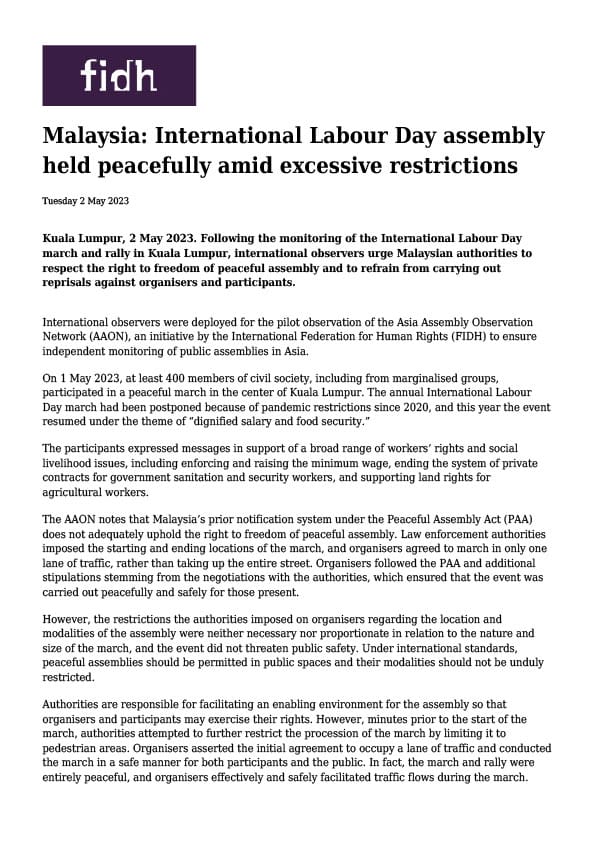
Malaysia: International Labour Day assembly held peacefully amid excessive restrictions
2 May 2023