
How to observe an assembly
This chapter covers the period of time before the departure of the assembly observation mission to the country where the assembly takes place.
How to observe an assembly
During the observation mission
This section covers the period of time during which the members of the assembly observation mission are in the country where the assembly takes place.
In-person briefing with the assembly observation mission members
The member/partner organization(s) that facilitates the observation mission is required to conduct an in-person briefing with the members of the observation mission to provide an overview of the plans for the assembly observation and to review the risk assessment for the event. During the in-person briefing, logistics, such as modes of transportation, communications, equipment, and identification, should be provided.
Meetings with relevant stakeholders
Prior to the assembly, members of the observation mission should establish contact and meet with the assembly organizers and obtain information about the event, including: location and/or route; legal requirements, including official notification/authorization procedures; planned activities; modalities of the assembly (use of flags, banners, etc.); number of participants; duration; objectives, including the demands of the assembly; previous engagement with authorities; and interactions with/possible responses from the authorities during the assembly. Depending on the nature of the assembly, arrangements made to address any particular needs of specific assembly participant groups, such as persons with disabilities, children, and the elderly, should also be discussed.
A key protest organizer(s) should be identified to establish contact with the assembly observation mission members to receive information about the status of the assembly.
When it’s possible, and subject to a preliminary risk assessment [See, Before the assembly observation mission/Pre-departure risk assessment], members of the observation mission could meet with: counter demonstrators; law enforcement officials responsible for the management and policing of the assembly; members of National Human Rights Institutions; members of the media.
Assembly observation mission members may also meet with other relevant stakeholders, such as: representatives from the Ministry of Foreign Affairs; foreign diplomats; local authorities; members of civil society; and members of Parliament from opposing sides of the political spectrum.
Survey of the assembly site
In the days ahead of the assembly, the members of the assembly observation mission should use an online/offline/physical map of the protest site and visit the site where the assembly will take place to familiarize themselves with the location and, in case of a march/procession, its route. Members of the assembly observation mission should be informed on whether the assembly is stationary or mobile, such as a procession or march. If the assembly follows a certain route, members of the observation mission should walk the route of the assembly and familiarize themselves with the direction the route is expected to follow. They should acquaint themselves with key locations, main buildings, structures, commercial establishments, prohibited assembly areas, and escape routes. They should also be mindful of places that may result in possible tensions (i.e. construction sites where equipment could be used as weapons; procession routes in the vicinity of high security zones; etc.).
It is crucial for members of the observation mission to know the best escape routes in the event of escalating violence/tension that may pose a risk to their personal safety.
Deployment of the members of the assembly observation mission
On the day(s) of the assembly, members of the assembly observation mission should be positioned in a manner that makes them feel safe and viewed as independent observers and not as participants in the assembly. Depending on the number of members of the assembly observation mission, their placement should be pre-determined.
Members of the assembly observation mission should position themselves away from possible dangers, such as the direct line of fire, water cannons, teargas, and physical confrontation. They should also take into consideration the wind direction if there is a possibility that teargas may be used.
Where feasible, a representative/staff of the member/partner organization may be required to carry out a remote observation of the assembly in order to provide the assembly observation members with the necessary information related to security, logistical, and operational aspects and developments related to the assembly. The remote observer must communicate and maintain contact at all times with the observation observation members on the ground.
If an assembly takes place during prolonged periods of time, a safe location in the vicinity should be identified for assembly observers to rest. In such circumstances, the assembly observation members may be establish a rotation and shifts to conduct the observation.
Communication with the assembly observation mission members
Members of the assembly observation mission should be able to communicate with one another at all times. Depending on the circumstances and network connectivity, they could be given local SIM cards by the FIDH Asia Desk or the local member/partner organization(s). Alternative modes of communication should be decided in the event of no/limited/poor network connectivity or mobile phone signals during the assembly.
Risk assessment
Members of the assembly observation mission should be informed about potential threats arising from the policing authorities and/or counter demonstrations. A meeting point and time should be established for members of the assembly observation mission to gather at the end of the assembly or if dangers for the observation members emerge and the observation has to be suspended.
Recording devices
Electronic recording devices are important tools that assist members of the assembly observation mission in documenting what takes place during the assembly. Members of the assembly observation mission should photograph and/or record incidents and proceedings during the assembly as much as possible. A secured online space will be provided by the FIDH Asia Desk to store and preserve all audiovisual digital resources relevant to the assembly observation mission.
Forms of identification for the assembly observation mission members
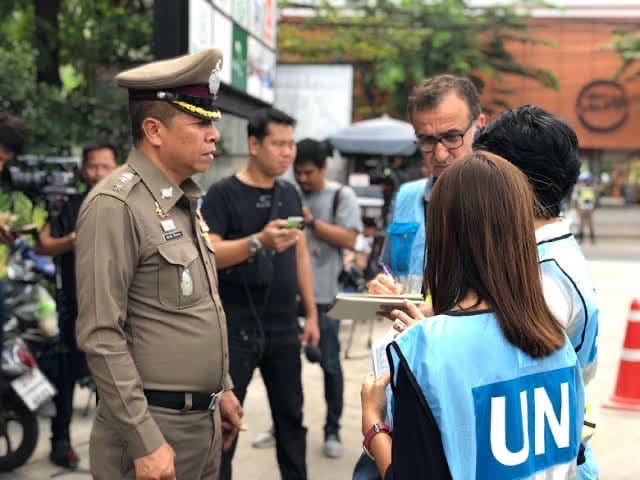
Depending on the circumstances of the assembly, and subject to a preliminary risk assessment [See, Before the assembly observation mission/Pre-departure risk assessment], members of the assembly observation mission could be provided with a form of identification or accreditation that identifies them as international independent observers. This can be a jacket, a card, a badge, an armband, or similar.
Upon assessing the context of the assembly, the member/partner organization(s) and the FIDH Asia Desk will determine whether the members of the assembly observation mission should be identifiable by the authorities and assembly participants. Such determination requires the consensual agreement of all members of the observation mission.
Regardless of the determination on the identification, the member/partner organization should provide the members of the observation mission with a brief letter that explains the objective and purpose of the assembly observation and the identity of the members. Such letter may be used in the event of any controversy or misunderstanding arising with law enforcement, protest participants, or other third parties. The name(s) and contact details of the emergency contact should be indicated in the letter. The letter should be in both English and at least one official language of the country where the assembly takes place.
What to observe and document during an assembly
Members of the assembly observation mission should provide an objective and factual account of what they witness before, during, and after the assembly, in relation to the conduct of both assembly participants, law enforcement officials, and other groups and individuals (counter demonstrators, medical personnel, journalists, lawyers, and other observers).
In completing the template provided below, the assembly observation mission members should only include information that they witnessed first hand. They should clearly distinguish any secondary sources of information.
De-briefing session after the assembly
Within a short period of time after the end of the assembly, members of the observation mission should gather at a predetermined time and place to de-brief each other and share the preliminary findings of their observation. This discussion should include the scope of what should be included in the end-of mission statement, how the findings of the mission will be disseminated (i.e. through a press conference physically or after the mission delegates leave the country). The decisions of the observation team in consultation with the supporting FIDH member/partner organization should be communicated to the FIDH Asia Desk.
End of mission statement and press conference
Within 24 hours from the end of the assembly, the members of the assembly observation mission, in cooperation with the member/partner organization on the ground and in consultation with the FIDH Asia Desk, should produce an English language end-of-mission statement that contains the preliminary findings and recommendations of the observation, pending the final mission report [See After the assembly observation mission / Assembly observation report]. The end-of-mission statement should be translated into at least one official language of the country where the assembly is held and published no later than 48 hours from the end of the assembly and circulated to journalists, diplomatic missions and other relevant stakeholders. If a press conference cannot be organized, the end of mission statement can be disseminated locally and internationally.
Guidelines for end of mission statement
General guidelines: The end of mission statement should be approximately one-page long (about 500-600 words) and its emphasis should be on information based on observation of developments and analysis of the context and legal framework. Up to three recommendations should be included in the statement.
- Title (which should include the country concerned at the beginning: i.e. “Thailand: […])
- Opening paragraph
- Location / date (i.e. “Bangkok, 18 November 2022”).
- Key finding – it can include the key recommendation (one sentence).
- Second paragraph
- Key information about the assembly observed (i.e.: date/s, location, reason for assembly) (one sentence).
- Description of the Asian Assembly Observation network) (one sentence) 1.
- Body of the statement
- Key violations of international standards on freedom of assembly observed (about 300-400 words).
- Closing paragraph
- One-two final recommendations (two sentences, not bullet-pointed).
Subject to a risk assessment conducted by the FIDH Asia Desk and the member/partner organization(s), an in-country press conference may be held to publicize initial findings of the assembly observation, within 48 hours from the conclusion of the assembly. Alternatively, the press conference may be held by the member/partner organization(s) after all members of the observation mission have left the country.
Local observers collaboration
1 Suggested description: International observers were deployed as part of the Asia Assembly Observation Network (AAON), an initiative by the International Federation for Human Rights (FIDH) to ensure independent monitoring of public assemblies in Asia.
Follow-up meeting with assembly organizers
Where it is feasible, one or more members of the assembly observation mission should meet with assembly organizers after the conclusion of the assembly to:
- present and discuss the preliminary findings and recommendations of the observation;
- gather additional information;
- discuss follow-up documentation for the observation report [See After the assembly observation mission / Follow-up documentation].
During the mission check-list
- In-person briefing with the assembly observation mission members
- Meetings with relevant stakeholders
- Survey of the assembly site
- Deployment of members of the assembly observation mission
- Communication with the assembly observation mission members
- Risk assessment
- Recording devices
- Forms of identification for the assembly observation mission members
- De-briefing session after the assembly
- End-of-mission statement
- Press conference
- Follow-up meeting with assembly organizers
