
International standards
The international standards related to the right to freedom of peaceful assembly are based upon the following provisions of a human rights treaty and other non-enforceable instruments:
- Article 20 of the Universal Declaration of Human Rights (UDHR).
- Article 21 of the International Covenant on Civil and Political Rights ICCPR. (GC 37)
- UN Human Rights Committee’s General Comment 37 on Article 21 of the ICCPR.
- Basic Principles on the Use of Force and Firearms by Law Enforcement Officials. (BP)
- OHCHR Guidance on Less Lethal Weapons in Law Enforcement. (LLW)
The information below summarizes these standards and organizes them by aspects that should be taken into consideration by assembly observers.
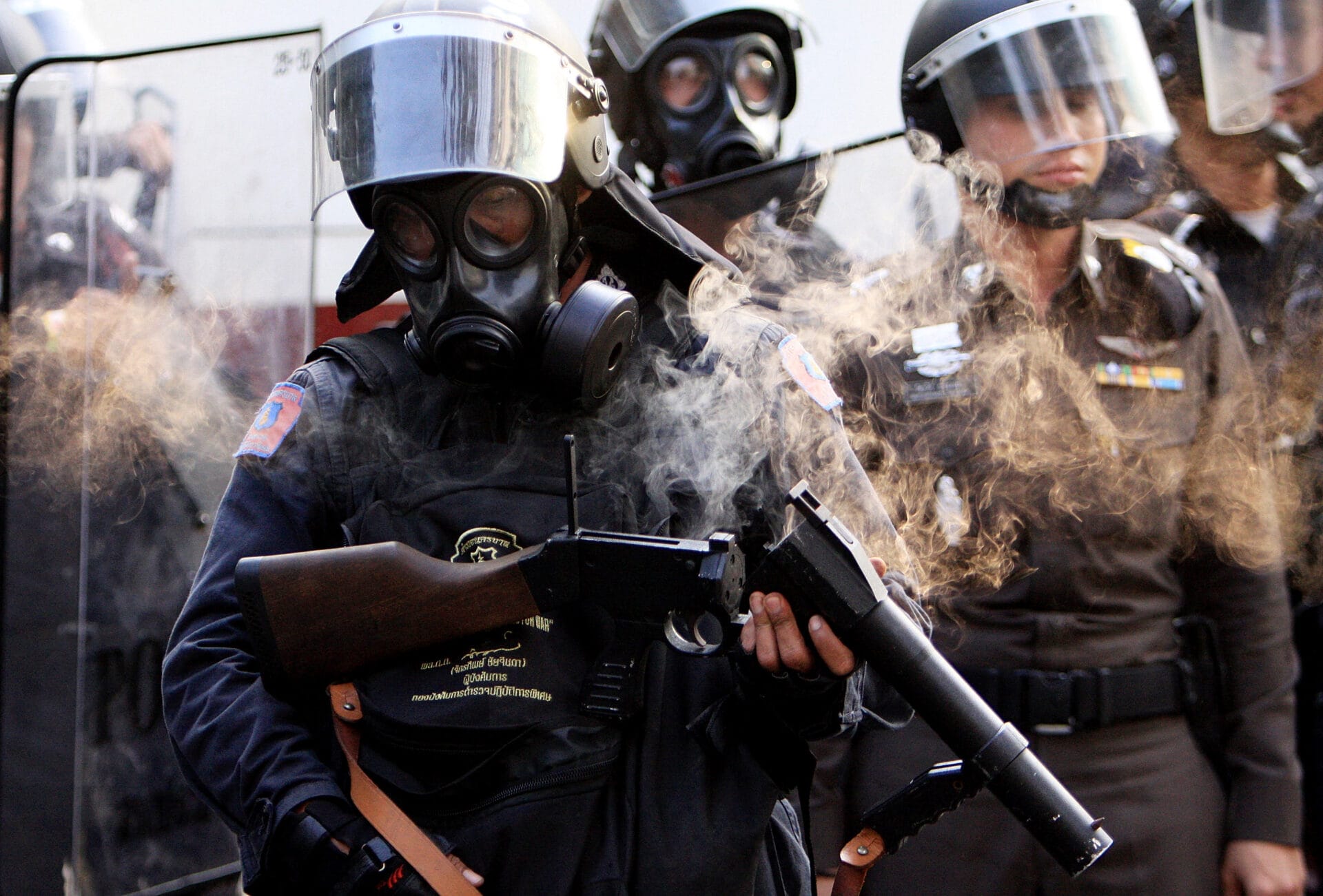
Photo by Chumsak Kanoknan / Getty Images AsiaPac / Getty Images via AFP
BANGKOK, THAILAND - OCTOBER 7: Riot Police shoot tear gas towards anti-government protesters outside The Parliament House on October 7, 2008, in Bangkok, Thailand. The violence began when police moved in firing teargas rounds to clear protesters from the streets outside parliament to allow politicians a means to exit..(Photo by Chumsak Kanoknan/Getty Images) (Photo by Chumsak Kanoknan / Getty Images AsiaPac / Getty Images via AFP)
Scope of the right to peaceful assembly
- Establishing whether or not someone’s participation in an assembly is protected under Article 21 of the ICCPR entails a two-stage process.
- It must be established whether the conduct amounts to participation in a “peaceful assembly.”
- It must be established whether any restrictions applied to the exercise of the right are legitimate (GC 37, para 11).
- Peaceful assemblies organized in advance, spontaneous assemblies, and counter demonstrations fall within the scope of Article 21 (GC 37, para 14).
- If the conduct of participants in an assembly is peaceful, the fact that certain domestic legal requirements of an assembly have not been met by its organizers or participants does not place the participants outside the scope of the protection of Article 21 (GC 37, para 16).
- The right to peaceful assembly protects the non-violent gathering by persons for specific purposes, principally expressive ones. It constitutes an individual right that is exercised collectively (GC 37, para 4).
Definition of a peaceful assembly
- Participating in an assembly entails organizing or taking part in a gathering of persons for a purpose such as expressing oneself, conveying a collective position on a particular issue, exchanging ideas, or asserting group solidarity or identity (GC 37, para 12).
- Assemblies that may be stationary, such as pickets, or mobile, such as processions or marches, are protected under Article 21 (GC 37, para 6).
- The nature and scale of an assembly may cause disruption whose consequences should not call into question the protection of such assemblies (GC 37, para 7).
- Peaceful assemblies can sometimes be used to pursue contentious ideas or goals (GC 37, para 7).
- Assemblies may take place indoors, outdoors, and online; in public or private places. It may take many forms including demonstrations, protests, meetings, processions, rallies, sit-ins, candlelit vigils, and flash mobs (GC 37, para 6).
Non-discrimination
- Everyone has the right of peaceful assembly: citizens; foreign nationals; migrants (documented or undocumented); asylum seekers; refugees, and stateless persons (GC 37, para 5).
- Authorities should facilitate and protect the right of peaceful assembly of individuals who are members of groups that have been subject to discrimination or face challenges participating in assemblies (GC 37, para 25).
- Authorities have a duty to protect participants from all forms of discriminatory abuse and attacks (GC 37, para 25).
Peaceful nature of an assembly
- There is a presumption in favor of considering assemblies to be peaceful. Isolated acts of violence by some participants should not be attributed to the other peaceful participants or the organizers (GC 37, para 17).
- The question of whether an assembly is peaceful must be looked at in reference to the violence that originates from the participants (GC 37, para 18).
- Violence against participants in a peaceful assembly by the authorities, or by agents acting on their behalf, or by members of the public, does not render an assembly non-peaceful (GC 37, para 18).
Violence at assemblies by participants
- Violence entails the use by participants of physical force against others that is likely to result in injury or death, or serious damage to property. Mere pushing and shoving or disruption of vehicular or pedestrian movement or daily activities do not amount to violence (GC 37, para 15).
- Participants’ conduct may be deemed violent if authorities can establish that, before or during the event: 1) participants are inciting others to use violence and such actions are likely to cause violence; 2) participants have violent intentions and plan to act on them; or 3) violence on their part is imminent (GC 37, para 19).
- “Isolated instances” of violence will not suffice to taint an entire assembly as no longer peaceful (GC 37, para 19).
- Where the incitement or intention of violence is “manifestly widespread”, participation in a gathering as such is no longer protected under Article 21 (GC 37, para 19).
Restrictions on the right to peaceful assembly
Criteria for permissible restrictions
- Legality: Limitations must be provided by law or administrative actions based on laws, which must be sufficiently precise and not give the authorities unfettered or sweeping discretion (GC 37, para 39).
- Necessary in a democratic society: Restrictions must be necessary and proportionate in the context of a society based on democracy, the rule of law, political pluralism and human rights, as opposed to being merely reasonable or expedient (GC 37, para 40).
- Proportionality: Restrictions requires weighing the detrimental impact of the authorities’ interference with the right against the benefits of such interference. Restrictions must be an appropriate response to a pressing social need and must be the least intrusive among the measures that might serve the necessary purpose (GC 37, para 40).
- Rather than imposing “prior restraint” to eliminate all risks, authorithies should consider allowing an assembly to take place and decide afterwards whether measures should be taken regarding possible transgressions during the event (GC 37, para 37).
- Blanket restrictions on assemblies are disproportionate. Any restrictions on participants should be based on a differentiated or individualized assessment of the conduct of the participants and the assembly concerned (GC 37, para 38).
- The possibility that a peaceful assembly may provoke an adverse or violent reaction by some members of the public is not sufficient ground to restrict the assembly (GC 37, para 27).
- The approach of authorities to restrictions must be content neutral and must not be based on the identity of the individual participants or their relations with the authorities (GC 37, para 22).
Grounds of restrictions
- Interest of national security: Restriction preserves the authorities’ capacity to protect the existence of the nation, its territorial integrity, political independence against a credible threat or use of force. Where the suppression of human rights is the very reason that national security has deteriorated, national security itself cannot be used to justify restricting the right to peaceful assembly (GC 37, para 42).
- Public safety: It must be established that the assembly creates a real and significant risk to the life or security of persons or a real and significant risk of serious damage to property (GC 37, para 43).
- Public order: Refers to the sum of the rules that ensure the proper functioning of society, or the set of fundamental principles on which society is founded, which also entails respect for human rights (GC 37, para 44).
- Public health: May exceptionally permit restriction where there may be an outbreak of an infectious disease and gatherings are dangerous. This may in extreme cases also be applicable where the sanitary situation during an assembly presents a substantial health risk to the general public or to the participants themselves (GC 37, para 45).
- Morals: Should only be exceptionally imposed based on the understanding on the universality of human rights, pluralism, and non-discrimination. This restriction on this ground should not be imposed because of opposition to expressions of sexual orientation or gender identity (GC 37, para 46).
- Rights and freedoms of others: Relate to the human rights of others not participating in the assembly. Assemblies by their very nature create a certain level of disruption and must be accommodated unless they impose a disproportionate burden for which restrictions should be justified (GC 37, para 47).
Restrictions on the content of the assembly
- Authorithies must leave to the participants to determine freely the purpose or any expressive content of an assembly (GC 37, para 22).
- Restrictions imposed must not be related to the message conveyed by the assembly (must be “content neutral”) (GC 37, para 48).
- Restrictions must not be used to stifle expression of political opposition to a government, including calls for changes of government, the constitution, the political system, or political independence for part of the country. They should not be used to prohibit insults to the honor and dignity of officials or state organs (GC 37, para 49).
Restrictions on the modalities of the assembly
- The use of flags, uniforms, signs and banners is to be regarded as a legitimate form of expression that should not be restricted. In exceptional cases, where such symbols are predominantly associated with incitement to discrimination, hostility or violence, restrictions may be justified (GC 37, para 51).
- Assembly participants should not be prohibited from wearing face coverings, such as hoods or masks, where there is no demonstrable evidence of imminent violence on their part and probable cause for arrest (GC 37, para 60).
- Participants should be left to determine whether they want to use equipment such as posters, megaphones, musical instruments or other technical means, such as projection equipment, to convey their message (GC 37, para 58).
- Assemblies may entail the temporary erection of structures, including sound systems, to reach their audience or otherwise achieve their purpose (GC 37, para 58).
Restrictions on the time of the assembly
- Peaceful assemblies are generally by their nature temporary, and should be left to end by themselves (GC 37, para 54).
- On restrictions on the time of assemblies, participants must have “sufficient opportunity” to manifest their views or pursue their other purposes effectively (GC 37, para 54).
- The timing, duration and frequency of a demonstration may play a central role in conveying its message to its target audience. However, the impact of continuous gatherings should not disproportionately impact the rights of others, such as assemblies held regularly at night in residential areas (GC 37, para 54).
Restrictions on the place of the assembly
- Restrictions should, as far as possible, allow participants to assemble “within sight and sound” of their target audience, or at whatever site is otherwise important to their purpose (GC 37, para 22).
- Peaceful assemblies may in principle be conducted in all places to which the public has access or should have access, such as public squares and streets (GC 37, para 55).
- Participants in assemblies may not be relegated to remote areas where they cannot effectively capture the attention of those who are being addressed, or the general public (GC 37, para 55).
- Blanket prohibitions, such as those on all assemblies anywhere in the capital or all the streets in the city, may not be imposed (GC 37, para 55).
- It should generally be avoided to designate the perimeters of public places such as courts, parliament, sites of historical significance or other official buildings as areas where assemblies may not take place (GC 37, para 56).
Obligations of the authorities
- The fundamental human rights of participants should be respected and protected, even if an assembly is considered unlawful by the authorities (LLW, para 6.3.1). Authorities must ensure there is no unwarranted interference with peaceful assemblies, such as prohibiting, dispersing, blocking or disrupting peaceful assemblies without “compelling justification (GC 37, para 23).
- Authorities must facilitate peaceful assemblies by promoting an enabling environment for the exercise of the right to peaceful assembly (GC 37, para 24).
- Authorities must protect participants against the possible abuse by non-state actors (GC 37, para 24).
- The obligations of authorities extend to associated activities which are integral for the assembly such as participants’ or organizers’ mobilization of resources; planning; dissemination of information about an upcoming event; preparation for and travelling to the event; communication between participants leading up to and during the assembly; broadcasting of or from the assembly; and leaving the assembly (GC 37, para 33).
- Authorities have an obligation to investigate effectively, impartially and in a timely manner any allegation or reasonable suspicion of unlawful use of force or other violations by law enforcement officials, including sexual or gender-based violence, in the context of assemblies (GC 37, para 90).
Sanctions for organizing/participating in assemblies
- No one should be harassed or face other reprisals as a result of their presence at, or affiliation with, a peaceful assembly (GC 37, para 33).
- Criminal or administrative sanctions imposed on organizers or participants of an assembly for their unlawful conduct must be proportionate, non-discriminatory, and should not be based on ambiguous or overbroadly defined offences (GC 37, para 67).
- Authorities may not require pledges or undertakings from individuals not to organize or participate in future assemblies (GC 37, para 66).
- The mere act of organizing or participating in a peaceful assembly cannot be criminalized under counter-terrorism laws (GC 37, para 68).
Notification regimes
- Notification regimes • Notification systems requiring organizers to inform the authorities in advance and provide certain salient details of the intended assembly are permissible to the extent necessary to assist the authorities in facilitating the smooth conduct of peaceful assemblies and protecting the rights of others (GC 37, para 70).
- Notification procedures should be transparent, not unduly bureaucratic, their demands on organizers must be proportionate to the potential public impact of the assembly concerned, and they should be free of charge (GC 37, para 70).
- If restrictions are imposed following a notification, they should be communicated early enough to allow time for access to the courts or other mechanisms to challenge them (GC 37, para 72).
- Any notification requirements for pre-planned assemblies must be provided for in domestic law (GC 37, para 72).
- Notification regimes must not in practice function as authorization systems (GC 37, para 73).
- Where authorization regimes persist in domestic law, they must in practice function as a system of notification, with authorization being granted as a matter of course, in the absence of compelling reasons to do otherwise (GC 37, para 73).
- Lack of notification does not absolve the authorities from the obligation, within their abilities, to facilitate the assembly and to protect the participants (GC 37, para 71).
- A failure to notify the authorities of an upcoming assembly, where required, does not render the act of participation in the assembly unlawful, and must not in itself be used as a basis for dispersing the assembly or arresting the participants or organizers, or for imposing undue sanctions, such as charging the participants or organizers with criminal offences (GC 37, para 71).
Rights of assembly observers and media persons
- Assembly observers (such as human rights defenders, journalist, national human rights monitoring institutions, and others involved in observation or reporting on assemblies) are entitled to the protection under the ICCPR (GC 37, para 30).
- The state should not prohibit or unduly limit observers from monitoring the actions of law enforcement officials (GC 37, para 30).
- Participants, journalists, and observers have the right to record the actions of law enforcement officials (GC 37, para 94).
- Observers must not face reprisals or other harassment, and their equipment must not be confiscated or damaged (GC 37, para 30).
- Even if an assembly is declared unlawful or is dispersed, that does not terminate the right to observe an assembly (GC 37, para 30).
Communication technology
- Article 21 protection also extends to remote participation in, and organization of, assemblies, for example online (GC 37, para 13).
- Authorithies must not block or hinder Internet connectivity in relation to peaceful assemblies. The same applies to geotargeted or technology-specific interference with connectivity or access to content (GC 37, para 34).
Law enforcement and policing of assemblies
- The policing of an assembly should be planned and conducted with the objective of enabling the assembly to take place as intended to minimize the potential for injury to any person and damage to property (GC 37, para 76).
- Only law enforcement officials trained in the policing of assemblies, including on the relevant human rights standards, should be deployed for that purpose (GC 37, para 80).
- Law enforcement officials should seek to de-escalate situations that might result in violence (GC 37, para 78).
- The military should not be used to police assemblies (GC 37, para 80).
- In exceptional circumstances and on a temporary basis, if military personnel are deployed in support, they must have received appropriate human rights training and must comply with the same international rules and standards as law enforcement officials (GC 37, para 80).
Use of force
- Law enforcement should seek to deescalate situations that might result in violence. They are obliged to exhaust non-violent means and give prior warning if it becomes absolutely necessary to use force, unless exhausting non-violent means or giving prior warning would be manifestly ineffective (GC 37, para 78).
- At all times, law enforcement officials should consider and minimize the possible impact of their use of force on bystanders, passers-by, medical personnel, and journalists (LLW, para 2.10).
- When lawful use of force is unavoidable, law enforcement should:
- Exercise restraint and act in proportion to the seriousness of the offence and the legitimate objective to be achieved.
- Minimize damage and injury, and respect and preserve human life.
- Ensure that assistance and medical aid are rendered to any injured or affected persons at the earliest possible moment.
- Ensure that relatives or close friends of the injured or affected person are notified at the earliest possible moment (BP, Principle 5).
Necessity
- Law enforcement officials should use force only when it is absolutely necessary in order to achieve a lawful and legitimate law enforcement objective (LLW, para 2.8)
- The principle of necessity requires that, to achieve a legitimate law enforcement objective, no reasonable alternative appears available at that moment other than resorting to the use of force (LLW, para 2.9).
- When the use of force is reasonably necessary, only the minimum force required to achieve that objective shall be used (LLW, para 2.9).
- The use of force must cease as soon as it is no longer necessary (LLW, para 2.9).
Proportionality
- The type and level of the force used and the harm that may reasonably be expected to result from it shall be proportionate to the threat posed by an individual or group of individuals (LLW, para 2.10).
- Law enforcement officials may not use greater force than is proportionate to the legitimate objective of either dispersing an assembly, preventing a crime, or effecting or assisting in the lawful arrest of offenders or suspected offenders (GC 37, para 79).
- Where force is proportionate and is necessary to achieve a legitimate law enforcement objective, “all possible precautionary steps” should be taken to avoid, or at least minimize, the risk of injury or death (LLW, para 6.3.1).
Use of firearms
- The use of firearms to disperse an assembly is always unlawful (LLW, para 6.3.4).
- In situations where some force is necessary, only less-lethal weapons may be used (LLW, para 6.3.4).
- Any use of firearms by law enforcement officials in the context of assemblies must be limited to targeted individuals in circumstances in which it is strictly necessary to confront an imminent threat of death or serious injury (GC 37, para 88).
- It is never lawful to fire indiscriminately or to use firearms in fully automatic mode when policing an assembly (GC 37, para 88).
Less lethal weapons
- Authorithies must ensure that officers deployed with all weapons, including less-lethal weapons, receive specific training in their use (GC 37. para 81).
- The deployment of non-lethal incapacitating weapons (such as batons, collective gas spray, water cannon) should be carefully evaluated and controlled in order to minimize the risk of endangering uninvolved persons (BP, para3).
- If it is decided that less-lethal weapons are an appropriate means of addressing individual acts of violence, due care should be given to the likely proximity of third parties and bystanders (LLW, para 6.3.2).
- Less-lethal weapons that can be individually aimed should target only individuals engaged in acts of violence (GC 37. para 6.3.4).
- Weapons such as chemical irritants dispersed at a distance (such as tear gas) should be targeted at groups of violent individuals unless it is lawful in the circumstances to disperse the entire assembly (GC 37. para 6.3.4).
- Less-lethal weapons with wide-area effects, such as tear gas and water cannons, should be used only as a measure of last resort, following a verbal warning, and with adequate opportunity given for assembly participants to disperse (GC 37. para 87).
Containment
- Containment (“kettling”), where law enforcement officials encircle and close in a section of the participants, may be used only where it is necessary and proportionate to do so, in order to address actual violence or an imminent threat emanating from that section (GC 37. para 84).
- Particular care must be taken to contain, as far as possible, only people linked directly to violence and to limit the duration of the containment to the minimum necessary (GC 37. para 84).
- Necessary law enforcement measures targeted against specific individuals are often preferable to containment (GC 37. para 84).
Dispersal of assemblies
- General principles:
- An assembly be dispersed only in “exceptional cases.” Dispersal may be resorted to if the assembly is no longer peaceful, or if there is clear evidence of an imminent threat of serious violence that cannot be reasonably addressed by more proportionate measures, such as targeted arrests (GC 37. para 85).
- Before approving dispersal, law enforcement agencies should seek to identify any violent individuals and isolate them from the other participants. This may enable the main assembly to continue (LLW, para 6.3.3).
- If targeted interventions are ineffective, law enforcement officials may employ weapons that target groups rather than individuals (such as water cannon or tear gas) after having issued an appropriate warning, unless giving the warning would cause a delay that would either risk causing serious injury or be futile (LLW, para 6.3.3).
- In addition, participants in the assembly should be given time to obey the warning and a safe space or route for them to move to shall be ensured (LLW, para 6.3.3).
- Dispersal of unlawful non-violent assemblies:
- In the dispersal of assemblies that are unlawful but non-violent, law enforcement officials shall avoid the use of force or, where that is not practicable, shall restrict such force to the minimum extent necessary (BP, para 13).
- Dispersal of violent assemblies:
- In the dispersal of violent assemblies, law enforcement officials may use firearms only when less dangerous means are not practicable and only to the minimum extent necessary (BP, para 14).
- Dispersal of peaceful assemblies causing high levels of disruption:
- An assembly that remains peaceful while nevertheless causing a high level of disruption, such as the extended blocking of traffic, may be dispersed, as a rule, only if the disruption is “serious and sustained.” (GC 37. para 85).
Water cannons
- In general, water cannon should only be used in situations of serious public disorder where there is a significant likelihood of loss of life, serious injury or the widespread destruction of property (LLW, para 7.7.2).
- In order to meet the requirements of necessity and proportionality, the deployment of water cannon should be carefully planned and managed with rigorous command and control at a senior level (LLW, para 7.7.2).
- Water cannon shall not target a jet of water at an individual or group of persons at short range owing to the risk of causing permanent blindness or secondary injuries if persons are propelled energetically by the water jet (LLW, para 7.7.4).
- Water cannon shall not be used against restrained persons or persons otherwise unable to move (LLW, para 7.7.4).
- Water cannon should not be used against persons in elevated positions, where there is a risk of persons slipping or being forced by the jet against walls or hard objects (LLW, para 7.7.3).
Chemical irritants launched at a distance
- A range of chemical irritants (teargas, malodorants) can be launched from a distance at groups of individuals engaged in violent acts (LLW, para 7.3.1). In such circumstances, they should be fired at a high angle (LLW, para 7.3.2).
- Chemical irritants should not be fired at the head or face, owing to the risk of death or serious injury from impact trauma (LLW, para 7.3.6).
- In general, chemical irritants should not be used in confined spaces, where there is no viable exit or adequate ventilation, owing to the risk of death or serious injury from asphyxiation (LLW, para 7.3.7).
- Chemical irritants that contain hazardous levels of active agents shall not be used (LLW, para 7.3.8).
Detention and arrests
- Preventive detention of targeted individuals to keep them from participating in assemblies may constitute arbitrary deprivation of liberty, which is incompatible with the right to freedom of peaceful assembly (GC 37, para 82).
- Practices of indiscriminate mass arrest prior to, during, or following an assembly are arbitrary and unlawful (GC 37, para 82).
- The mere fact that authorities associate an individual with a peaceful assembly does not constitute reasonable grounds for stopping and searching them (GC 37, para 83).
