
Country Profile
Vietnam
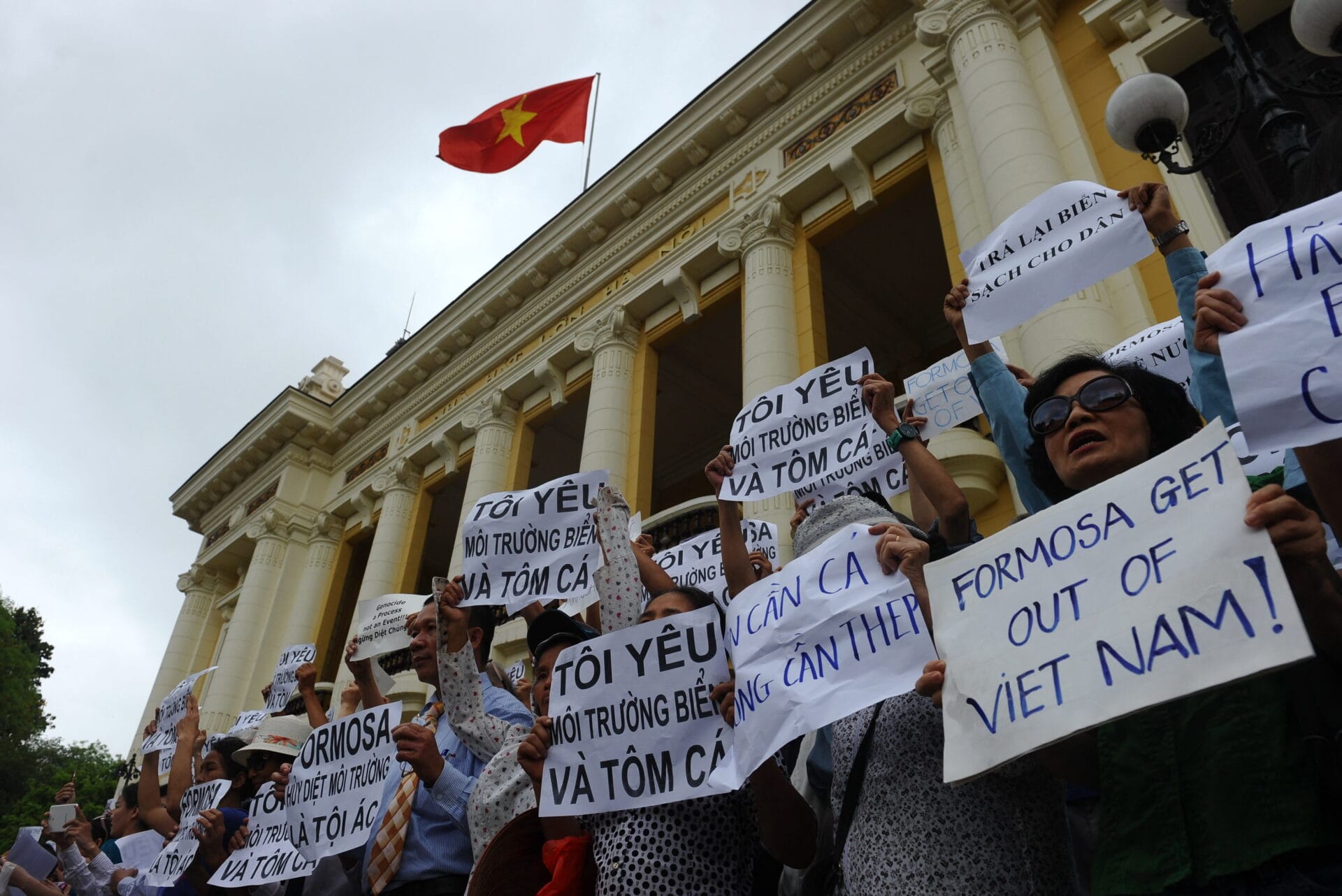
Vietnamese protesters demonstrate against Taiwanese conglomerate Formosa during a rally in downtown Hanoi on May 1, 2016. Around a thousand people poured into Vietnam's two major cities Hanoi and Ho Chi Minh City to protest against Taiwan's Formosa, which operates a steel plant which they claim is causing mass fish kills due to pollution in Vietnam's central coast. (Photo by HOANG DINH NAM / AFP)
Member organization
Contact Person(S)
Vo Tran Nhat
Penelope Faulkner
Latest update (mm/year)
August 2022
Political context
Form of government (military dictatorship; one-party state; multi-party democracy; nominally civilian government)
One-party state, ruled by the Communist Party of Vietnam (CPV).
Situation of elections (free/fair; high election-related violence; farcical election; no elections; date of latest elections)
Elections are neither fair nor free. Voting is mandatory, but there are no opposition parties. Independent candidates are vetted by CPV authorities, very few are approved (some are arrested). In the latest legislative elections in May 2021, 868 (or 92%) of the candidates were CPV members, with 74 independents – less than in the previous elections. Of 499 seats in the National Assembly, 485 went to VCP members and 14 to independents.
Space for civil society
Space for civil society is extremely limited. Associations must be registered under state institutions, which can intervene to ban activities and membership. Activists are often arrested, harassed, intimidated, placed under surveillance/house arrest and barred from travelling abroad. The government has refused to establish mandatory “Domestic Advisory Group” of independent civil society to monitor implementation of the EU-Vietnam Free Trade Agreement and has arrested two members of prominent CSOs who applied for DAG membership.
Media environment
The media environment is not free. There is no independent press or media, which is controlled by the CPV. Online censorship is pervasive. The government filters and controls Internet content and harshly punishes users. Defence Ministry and Police mandate “Internet warriors” such as Force 47 (10,000 agents) to intercept and oppose “wrong views.” Arrests are frequent. Facebook and other social networks are present, but subjected to government pressure (in 2020, Facebook censored many accounts, but later blocked government “influencers” as well).
Independence of the judiciary
The judiciary is not independent and is Institutionally linked to the CPV. Trials are unfair. Accused persons have no access to lawyers or family members. Article 19 of the Criminal Code, as amended in 2015, oblige lawyers to reveal information on their clients in “national security” cases.
Repressive laws (unrelated to assemblies or COVID-19)
Repressive and vaguely-worded “national security” clauses in the 2015 Criminal Code make no distinction between violent activities and the peaceful exercise of freedom of expression (i.e. subversion (Article 109), making or storing anti-state materials (Article 117), and abusing democratic freedoms to infringe upon state interests (Article 318). Several articles carry the death penalty. Many other important laws, such as the Press Law, the Law on Belief and Religion, and the Publishing Law, contain similar provisions prohibiting activities deemed to oppose the state and tarnish the reputation of state leaders.
Respect for human rights
Vietnam has acceded to seven key international human rights treaties (CCPR, CSCER, CEDAW, CERD, CAT, CRC, CRPD) but only one Optional Protocol (CRC), greatly limiting the possibility to file individual complaints to committees attached to those treaties. In practice, domestic legislation nullifies the rights enshrined in those treaties. The government has routinely refused to accept key UPR recommendations, such as those calling for the reform of the Criminal Code. Because there are no free press, no free trade unions, or independent CSOs, and the judiciary is not independent, victims of rights violations have no access to effective mechanisms to seek redress for their grievances.
Conflict areas
N/A
Forms of ideological extremism (religious, political, sectarian)
N/A
COVID-situation (unrelated to assembly restrictions)
Overall, the Vietnamese government has been praised for COVID-19 handling. Authorities acted swiftly, closing borders and placing travellers in camps for quarantine, but the vaccine rollout was extremely slow. Pervasive government controls resulted in nationwide clampdowns and the mobilization of police and local authorities to strictly enforce them. People discussing the government’s negative handling of COVID-19 on social media were censored. Prisoners complained of high infection rates.
Legal framework
Constitutional provisions related to the right to peaceful assembly (article number(s); text of the provision(s))
Article 25 of the Constitution states: “Citizens have the right to freedom of speech and freedom of the press, and have the right of access to information, the right to assembly, the right to association, and the right to demonstrate. The exercise of those rights shall be prescribed by law.”
Specific law(s) related to public assemblies (name of the law(s); date of adoption and promulgation)
- Decree 38 (issued by the Prime Minister in 2005) prohibits gatherings outside state agencies and public buildings and bans all protests deemed to “interfere with the activities” of the CPV, leaders and state organs. Circular 09/2005/TT-BCA, issued by the Ministry of Public Security to implement Decree 38/2005, prohibits gatherings of more than five people without obtaining prior permission from the authorities.
- Ministry of Public Security Circular 13/2016/TT-BCA, which came into effect in April 2016, contains instructions on the policing of “gatherings causing public disorder in the vicinity of trials.” Article 14 of Circular 13 authorizes police to “immediately deploy forces to prevent the disturbance of public order, isolate and arrest opposition elements, instigators and leaders of the disturbance.” Police have frequently invoked Circular 13 to violently attack and detain activists and human rights defenders who protested against unfair trials or gathered outside the courts to express solidarity with fellow activists.
- Article 318 of the Criminal Code on “causing public disorder” has been routinely used to arrest, prosecute, and imprison high-profile activists and human rights defenders for the exercise of their right to freedom of peaceful assembly.
Main obstacles /restrictions to public assemblies (for example: notification requirements; ban on assemblies and reasons for the ban; persons who are barred from organizing/participating in an assembly; places where assemblies cannot be held; grounds for dispersal)
[See above, 2. Specific law(s) related to public assemblies (name of the law(s); date of adoption and promulgation)]
Other laws/decrees that are frequently used to arrest demonstrators and/or limit the right to freedom of assembly
Articles 318 and 331 of the Criminal Code [See below, 5. Penalties for violating law(s) relating to public assemblies].
Penalties for violating law(s) relating to public assemblies (for example: fines, jail terms)
Article 331 of the Criminal Code:
- Any person who abuses the freedom of speech, freedom of the press, freedom of religion, freedom of association, and other democratic freedoms to infringe upon the interests of the state, lawful rights and interests of organizations and/or citizens shall receive a warning or face a penalty of up to three years’ community sentence or six to 36 months’ imprisonment.
- If the offense has a negative impact on social security, order, or safety, the offender shall face a penalty of two to seven years’ imprisonment.
Article 318 of the Criminal Code:
- Any person who causes disturbance of public order which negatively impacts social safety, order, or security, or previously incurred a civil penalty for the same offense or has a previous conviction for the same offense which has not been expunged, shall be liable to a fine of from VND 5,000,000 (US$ 217) to VND 50,000,000 (US$ 2,174) or face a penalty of up to two years’ community sentence or three to 24 months’ imprisonment.
- This offense committed in any of the following cases shall carry a penalty of two to seven years’ imprisonment.
There are also many administrative decrees that prescribes fines for similar offenses.
Laws relating to restrictions on public assemblies/gatherings in the context of COVID-19
The Prime Minister issued two Directives concerning COVID-19, Directive 15, on 27 March 2020, and Directive 16, on 31 March 2020. The two differ slightly, and are applied according to the degree of contagion. Decree 15 bans gatherings of 10 people or more, excluding offices, schools or hospitals. Decree 16 bans gatherings of more than two people in the same circumstances. Decree 15 bans assemblies or gatherings of over 20 people in one room. Decree 16 urges people to avoid all gatherings, stay at home and only go outside for reasons of basic necessity. The Ministry of Public Security and the People’s Committees at the national, provincial, municipal, and village level are in charge of enforcing the Decrees.
Law enforcement
Use of force during demonstrations (for example: batons; rubber bullets; teargas; water cannons; firearms; lethal force)
Batons, rubber bullets, teargas, water cannons, and firearms have been used. Lethal force is rare.
Harassment of protesters before, during, and after demonstrations (for example: surveillance, threats, arrests, photographing protesters, filing of criminal charges)
Surveillance, threats, arrests, filing of criminal charges against protesters and protest organizers have occurred.
Use of non-law enforcement personnel (military or paramilitary personnel or units; vigilantes, militia)
Government-hired thugs and plain-clothed security agents are regularly used to harass, intimidate, and beat demonstrators.
Presence of counter-protesters or other non-state actors
Counter protesters are found more often on the Internet.
Accountability for abuses committed by law enforcement agencies and assembly participants
There is no accountability for abuses committed by law enforcement agencies. Assembly participants are routinely arrested, regardless of their engagement in acts of violence.
Recent protests
NA
Logistical information
Visa requirement for foreign observers to conduct assembly monitoring
Visa applications to conduct assembly monitoring, you will be refused. Debbie Stothard of FIDH was detained in Hanoi airport simply because she sought to enter the country to speak at a forum on Business and Human Rights in September 2018. FIDH has been systematically refused visas to attend the Asia-Europe Meeting (ASEM) People’s Forums in Vietnam. If foreigners enter Vietnam as tourist and conduct assembly monitoring without permission, they may be arrested and expelled for violating the conditions of their entry as tourists.
Exemptions of visas for certain countries/nationalities
Visa exemptions are granted to national of the following countries: Belarus; Brunei; Cambodia; Denmark; Finland; France; Germany; Indonesia; Italy; Japan; Laos; Malaysia; Myanmar; Norway; Philippines; Russia; Singapore; South Korea; Spain; Sweden; Thailand; and the United Kingdom.Nationals from the countries listed below can apply online for an e-visa (fee; US$ 25; processing time: three working days):
Andorra, Argentina, Armenia, Australia, Austria, Azerbaijan, Belarus, Belgium, Bosnia and Herzegovina, Brazil, Brunei, Bulgaria, Canada, Colombia, Croatia, Cuba, Cyprus, Czech Republic, Chile, China (including Hong Kong and Macau passports), Denmark, Estonia, Fiji, Finland, France, Georgia, Germany, Greece, Hungary, Iceland, India, Ireland, Italy, Japan, Kazakhstan, Latvia, Liechtenstein, Lithuania, Luxembourg, Macedonia, Malta, Marshall Islands, Mexico, Micronesia, Moldova, Monaco, Montenegro, Mongolia, Myanmar, Nauru, Netherlands, New Zealand, Norway, Palau, Panama, Papua New Guinea, Peru, Poland, Portugal, Philippines, Qatar, Romania, Russia, Salomon Islands, San Marino, Serbia, Slovakia, Slovenia, South Korea, Spain, Sweden, Switzerland, Timor Leste, United Arab Emirates, United Kingdom, United States of America, Uruguay, Vanuatu, Venezuela, and Western Samoa.
Additional entry requirements during the COVID-10 pandemic:
- Proof of valid medical/travel insurance covering COVID-19 treatment. Minimum cover US$ 10,000.
- Downloaded PC-COVID-19 mobile app (Apple/Google Play) which must be presented to enter all establishments in the country.
- Visitors are requested to self-monitor for 10 days from entry, and to notify the nearest medical facility should they experience signs of COVID-19.
Security for foreigners (for examples: risk of denial of entry, deportation, arrests, targeted attacks)
Risk of denial of entry, deportation, arrests, targeted attacks.
Monitoring
Organizations/groups that engage in public assembly monitoring
Visa applications to conduct assembly monitoring, you will be refused. Debbie Stothard of FIDH was detained in Hanoi airport simply because she sought to enter the country to speak at a forum on Business and Human Rights in September 2018. FIDH has been systematically refused visas to attend the Asia-Europe Meeting (ASEM) People’s Forums in Vietnam. If foreigners enter Vietnam as tourist and conduct assembly monitoring without permission, they may be arrested and expelled for violating the conditions of their entry as tourists.
Mandatory or voluntary identification requirement for monitors (for examples: vests or cards)
N/A
Role of national human rights institution as an independent observer of assemblies
There is no national human rights institution.
Presence of media at assemblies
State-controlled media is sometimes present at demonstrations or assemblies, but is not necessarily authorized to report on them. Independent citizen journalists cover assemblies and post reports on blogs at their own risk. Many have been arrested for this.
